
How Howard County Probate Works
Maryland divides probate duties between two offices. The Register of Wills handles filings, record-keeping, and estate administration support. The Orphans' Court is the judicial body. It hears disputes between heirs, reviews personal representative conduct, and issues orders when the estate needs court supervision. Neither office provides legal advice, but the Register maintains a community attorney referral list for families that need help.
The practical flow is this: a family member or attorney files the estate papers with the Register of Wills. The Register reviews the filing, issues the appointment letters, and tracks the required reports. If things go smoothly, the Orphans' Court may never need to act at all. But if a creditor objects, if heirs fight over the will, or if a personal representative delays, a motion goes before the Orphans' Court judges. The court also handles continuance requests and motions for remote proceedings when in-person hearings are not practical. That structure keeps routine estates out of formal courtrooms while keeping a judge available for anything contested.
Both offices are at the Circuit Courthouse on Judicial Way in Ellicott City. Staff ask that you call ahead before visiting so they can explain which forms you need and what to bring.
Small Estates vs. Regular Howard County Probate
The first decision in any Howard County estate is whether the estate qualifies as a small estate or must go through regular probate. Maryland law sets the threshold in the Estates and Trusts Article, section 5-601. Small estates use a shorter process with fewer required filings. Regular estates require an inventory, periodic information reports, accounting, and a longer administration window. The Register of Wills can explain which category applies when you call before visiting.
For small estates, the process is leaner but the same parties are involved. A personal representative is still appointed and must still pay valid debts and taxes before distributing assets. The main difference is the number of required court filings. Regular estates require more steps, more notices, and more time. If an estate has real property titled only in the decedent's name, a regular estate is almost always required regardless of dollar value.
The Howard County Register of Wills page links a free guide, "Administering Estates in Maryland: A Basic Instructional Guide," which walks through both tracks in plain language. That guide is a good starting point before calling the office.
Howard County Probate Terms Explained
Probate filings use terms that can be confusing if you have not dealt with an estate before. The definitions below cover the words you will see most often in Howard County estate records and Orphans' Court proceedings.
- Testator
- The person who wrote and signed the will. When someone dies and leaves a valid will, that person is called the testator. The will names who gets the property and who is in charge of carrying it out.
- Executor / Personal Representative
- The person or institution appointed to manage and close the estate. Maryland statutes use the term "personal representative." The Register of Wills issues letters that give this person legal authority to act on behalf of the estate.
- Intestate
- Dying without a valid will. When someone dies intestate, Maryland's statute determines who inherits the property. The same probate process applies, but there is no will to guide distribution.
- Letters of Administration
- The official document issued by the Register of Wills that authorizes the personal representative to manage the estate. Banks and other institutions require these letters before releasing estate assets.
- Guardianship
- A court-ordered arrangement that gives one person legal authority to make personal decisions for another who cannot make those decisions independently. In probate, guardianship issues often arise when a decedent had minor children or when an heir is a person with a disability.
- Conservatorship
- Similar to guardianship but focused on managing property and finances rather than personal care decisions. The Orphans' Court in Howard County can supervise both types of proceedings.
How Probate Works in Howard County: Step by Step
The estate administration process in Howard County follows the steps set by Maryland law and the procedures of the Register of Wills office. Each step builds on the last. Missing a step or filing late can trigger Orphans' Court involvement even in routine cases.
- Determine estate size. Decide whether the estate qualifies as small or regular under Estates and Trusts Article, section 5-601. The answer controls which forms to file and how long the process takes.
- Locate the original will. If the decedent left a will, find the original signed copy. A copy alone is generally not enough. Living persons can also file a will for safekeeping with the Register of Wills before death using the procedure described on the Howard County Register page.
- Call the Register of Wills before visiting. The office at Suite 1100 in the Circuit Courthouse asks that you call ahead. Staff explain which forms apply to the estate and what documents to bring. This step saves time at the counter.
- File the petition and pay the filing fee. The petitioner files the estate petition with the required forms and pays the applicable filing fee. Fee amounts are posted at registers.maryland.gov/main/fees.html and can change, so confirm before you go.
- Personal representative receives letters. Once the petition is approved, the Register issues letters of administration or letters testamentary. Those letters are the legal authority the personal representative needs to open estate accounts, notify creditors, and manage property.
- Notice to interested persons and creditors. Required notices go out to heirs, legatees, and known creditors. This step opens the window during which claims against the estate may be filed.
- File inventory and information reports. The personal representative must file an estate inventory listing all assets and their values. Information reports follow on a schedule set by the Register.
- Review and pay claims. Valid creditor claims are paid from estate assets before any distribution to heirs. Disputed claims may require Orphans' Court review.
- File accounting and distribute assets. A final accounting shows what came in, what went out, and what remains. After the accounting is approved, assets are distributed to the heirs or legatees named in the will or determined by statute.
- Orphans' Court handles disputes and judicial issues. At any point in the process, a contested matter, a motion for continuance, or a request for a remote proceeding goes to the Orphans' Court. The court has judges who hear arguments, review evidence, and issue orders.
Howard County Orphans' Court and Register of Wills Location
Both the Orphans' Court and the Register of Wills office are in the Circuit Courthouse on Judicial Way in Ellicott City. The Register of Wills occupies Suite 1100. Parking in the courthouse garage is free. All visitors pass through security scanners before entering the building. The office is open Monday through Friday during normal business hours. RTA Route 403 serves the courthouse area for those using public transit.
The office cannot provide legal advice or notary services. A community attorney referral list is available on the Register's page for families that want legal help with an estate.
Register of Wills / Orphans' Court for Howard County
Circuit Courthouse, Suite 1100
9250 Judicial Way
Ellicott City, MD 21043
Fax: 410-313-3409
Mon-Fri 8:30am-4:30pm
Hon. Byron E. Macfarlane serves as the Register of Wills for Howard County. He was first elected in 2010 and is the 18th person to hold that office in the county's history. The Register's office is the starting point for all estate filings.
Searching Howard County Probate Records Online
The Maryland Register of Wills operates an estate search portal at registers.maryland.gov/main/search.html. The tool is public and free to use. Select Howard County as the jurisdiction, then search by estate number or by the decedent's name. Results show the estate status and the personal representative information where public. Not every detail of a probate file is visible online, but the portal is the fastest way to confirm whether an estate has been opened in Howard County.
For creditor claims specifically, a separate portal is available. The Register of Wills claim search lets you look up claims filed against an estate. That can matter if you are a creditor tracking whether your claim was received or if you are an heir verifying what debts are pending.
The claim search interface is an ASP.NET form. The screenshot below shows the portal as it appears to users searching for claims filed in Howard County estates.
The Register of Wills claim search portal is the official tool for looking up claims against open Howard County estates.
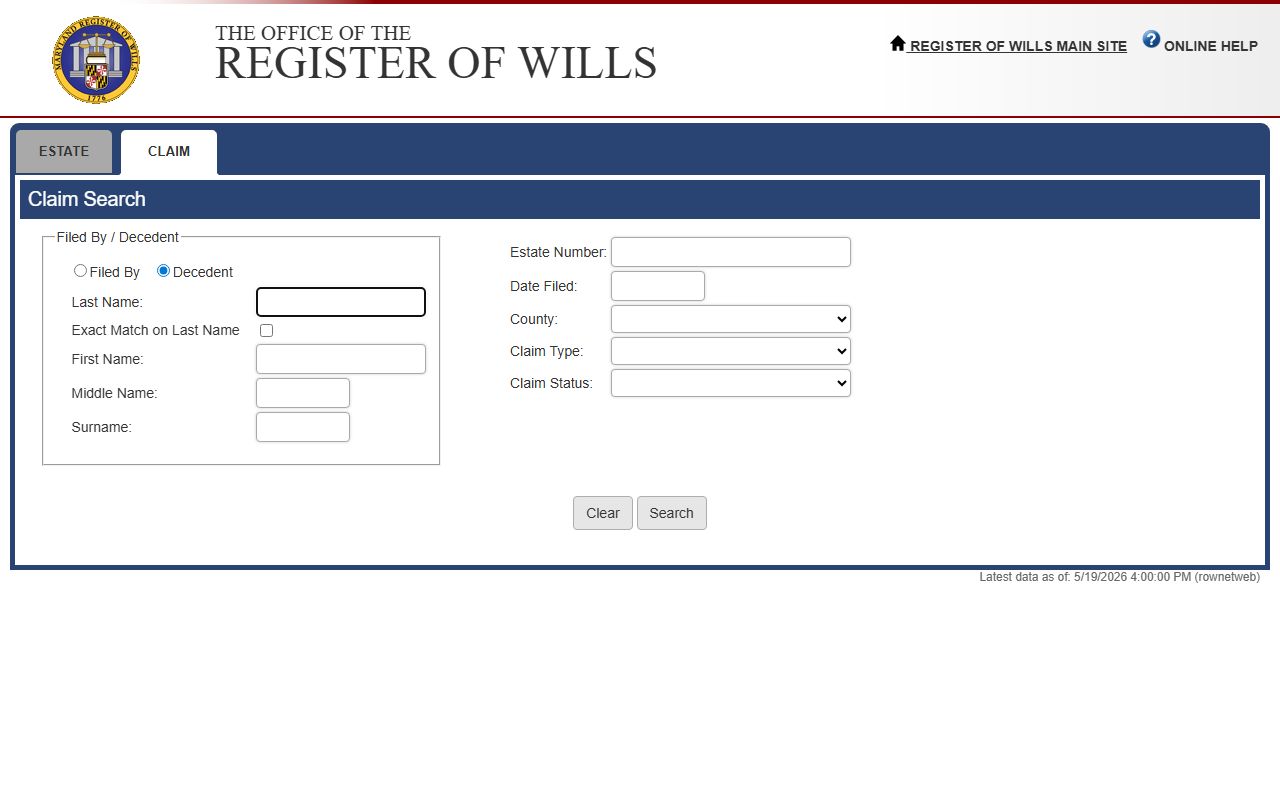
Using the claim search alongside the estate search gives a fuller picture of where a probate case stands before contacting the Register's office directly.
| Field Label | Type | Notes |
|---|---|---|
| County / Jurisdiction | Dropdown | Select Howard for local estates. |
| Estate Number | Text | Best exact lookup when you have it. |
| Decedent Last Name | Text | Strongly recommended for name searches. |
| Decedent First Name | Text | Optional; use if last name is common. |
| Date of Death / Filed Range | Date | Narrows results when a date range is known. |
| Search Button | Button | Submits the query. |
Howard County Probate Laws and Key Statutes
Maryland probate law is in the Estates and Trusts Article of the Maryland Code. The definitions that govern how estates are opened, how personal representatives are appointed, and how assets are distributed begin at Estates and Trusts Article, section 4-101. That section sets out the core terms used across all probate filings in Howard County.
The screenshot below shows the Maryland General Assembly statute text page for Estates and Trusts Article section 4-101, the definitions provision that anchors the entire probate framework.
Maryland Estates and Trusts Article, section 4-101 is the starting point for understanding the legal definitions used in Howard County probate proceedings.
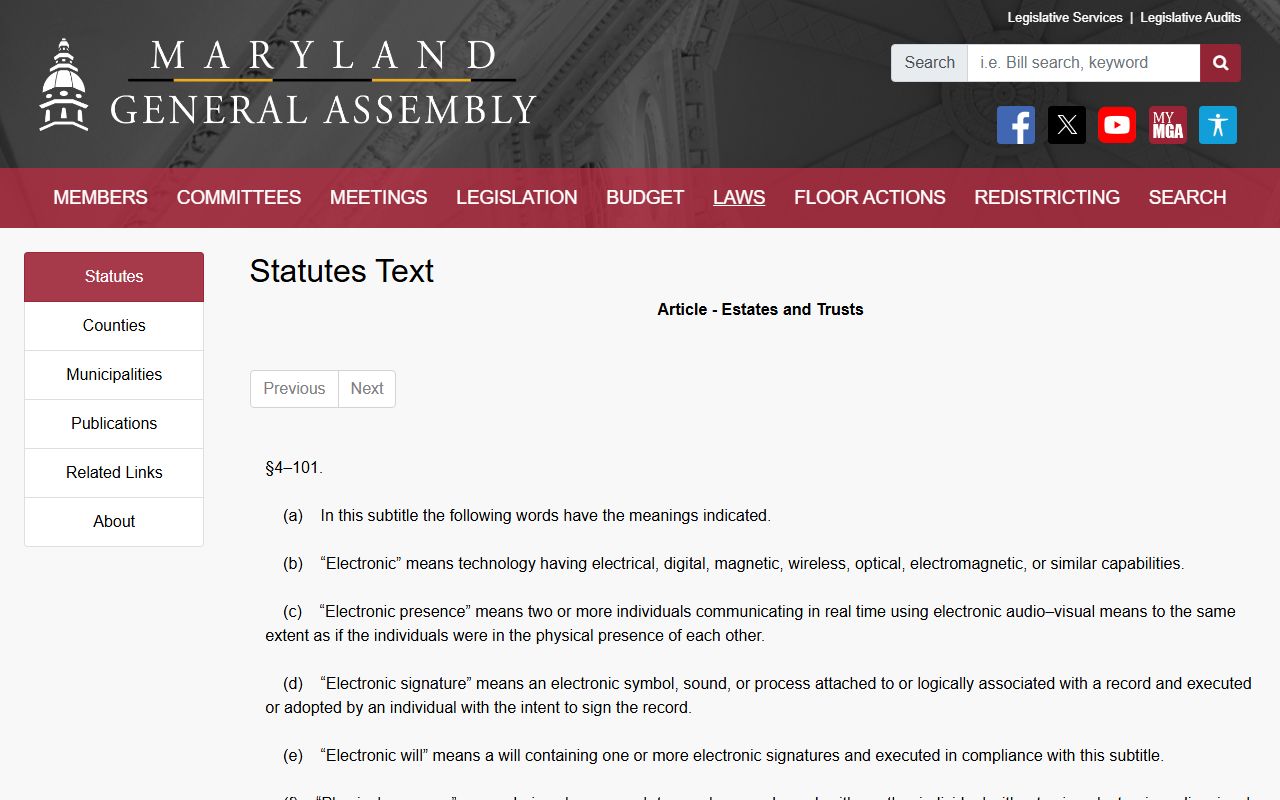
Those definitions feed directly into the procedures the Register of Wills and Orphans' Court apply when an estate is filed in Howard County.
The small estate threshold and procedure context appear at Estates and Trusts Article, section 5-601. That section is what separates a short-form small estate from a full regular probate, and knowing the threshold before filing can save a family several months and several filings.
Estates and Trusts Article, section 5-601 governs the small estate threshold in Maryland.
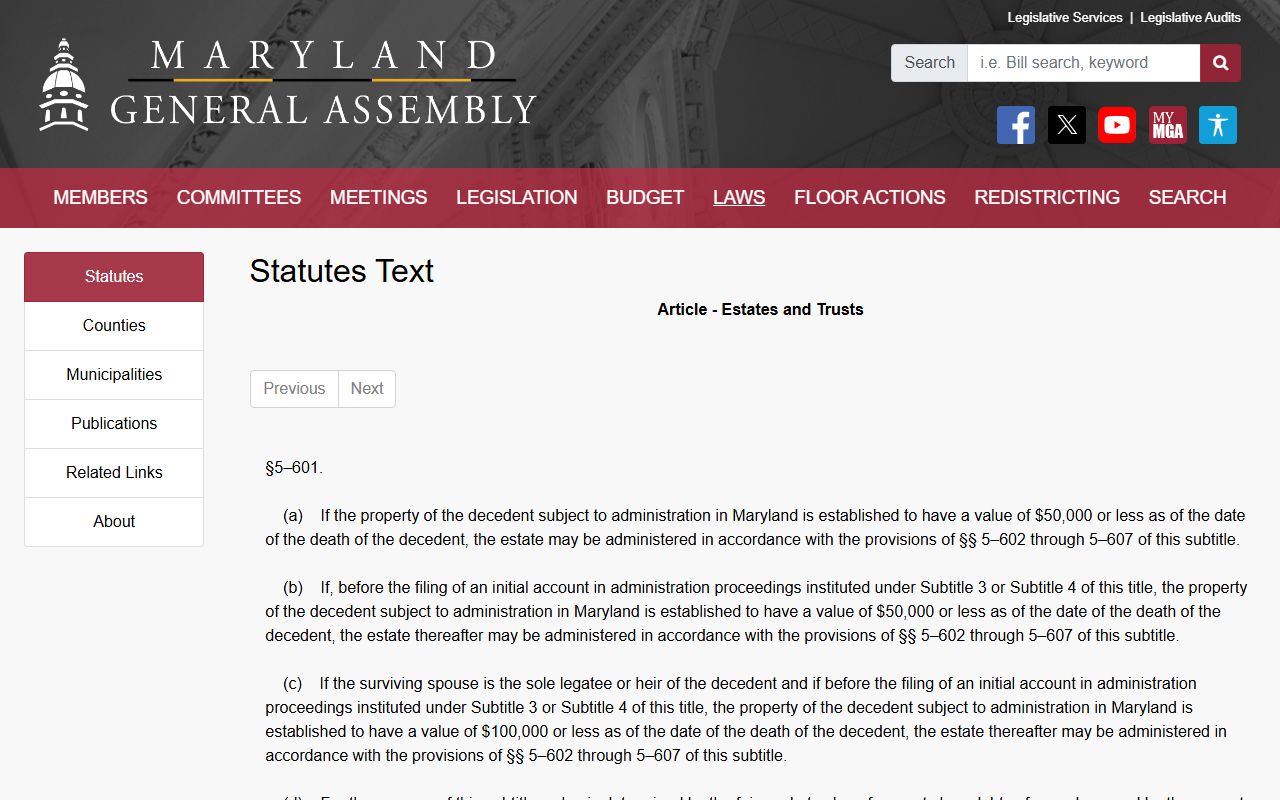
Reading section 5-601 alongside the Register's local forms and guides is the most direct way to decide which track applies to a Howard County estate before calling the office.
Howard County Probate Filing Fees
Maryland probate fees are set by statute and apply to all counties, including Howard County. The Register of Wills publishes the current fee schedule online. Because amounts can change when the legislature updates the fee statute, the authoritative source is always the Register's fee page rather than any printed or third-party source.
| Fee Item | Amount |
|---|---|
| Estate filing fee (all estate sizes) | See registers.maryland.gov/main/fees.html |
| Letters of administration / testamentary | See registers.maryland.gov/main/fees.html |
| Certified copy of estate document | See registers.maryland.gov/main/fees.html |
| Filing a will for safekeeping | See registers.maryland.gov/main/fees.html |
| Guardianship / conservatorship filing | See registers.maryland.gov/main/fees.html |
Note: Fee amounts are not reproduced here because they are set by statute and the Register's published schedule is the controlling source.
What the Howard County Orphans' Court Does
The Orphans' Court is a specialized court that sits within the Maryland court structure. In Howard County, Orphans' Court judges supervise estates where judicial involvement is needed. Most routine estates never come before them. The court becomes active when there is a dispute, a failure to file required reports, a contested will, or a request that only a judge can grant.
Common reasons a Howard County estate lands before the Orphans' Court include: a personal representative who fails to act or who acts improperly, heirs who dispute the will's validity or the proposed distribution, creditors whose claims are rejected and who want a hearing, requests for a continuance to extend a filing deadline, and motions to hold a proceeding remotely. The Register of Wills provides a standard form for continuance or postponement requests and a form for remote proceeding requests, both linked from the Howard County Register page.
The Orphans' Court does not handle criminal matters, civil lawsuits, or traffic cases. Those go to the Circuit Court or District Court. The Orphans' Court is limited to estate, guardianship, and conservatorship supervision, which keeps its docket focused.
Howard County Probate Forms and Resources
The Register of Wills for Howard County links several local forms and guides on the official office page. These are specific to Howard County administration and supplement the statewide forms available from the Maryland Register of Wills Association.
- Facts About Wills: a plain-language overview of what a will can and cannot do.
- Filing Your Will for Safekeeping: instructions for depositing an original will with the Register before death.
- Administering Estates in Maryland: A Basic Instructional Guide: the main step-by-step reference for personal representatives.
- Domestic Partners Probate Procedures and Inheritance Taxes in Maryland: covers the special rules that apply to domestic partnerships.
- Revocable Living Trusts: Get the Facts: explains how trusts interact with the probate process.
- Motion for Continuance or Postponement: the standard form used to request more time from the Orphans' Court.
- Motion for Remote Proceeding: the form used to request that a hearing be held by video or telephone rather than in person.
All forms are available at registers.maryland.gov/main/howard.html and through the statewide forms library at registers.maryland.gov/main/forms.html. The Maryland Judiciary also maintains a wills and estates help page for pro se filers.
Restricted Howard County Probate Records
Not all Howard County probate records are open to the public. Minor guardianship cases, certain mental health commitments, and sealed estate filings may be restricted by statute or court order. Financial-account numbers and Social Security numbers are redacted from public filings under statewide rules. An estate record may also be partially restricted if the court issues a protective order covering specific documents.
If you need a record that is not visible in the online estate search, you can contact the Register of Wills office directly. Staff can confirm whether a file exists and whether any part of it is open to the public. For records that require a court order to access, the Register can point you toward the right motion or form.