
Maryland Public Information Act and Howard County Records
Maryland's open-records statute is the Public Information Act, found in the General Provisions Article, Title 4. The Act defines what a "public record" is, who counts as a custodian, and when the public may inspect documents. Under General Provisions Section 4-101, a public record is any document, paper, photograph, recording, or other material that a unit of state or local government makes or receives in connection with its business. That definition is broad. It covers printed reports, electronic files, emails, photos, and audio recordings that county offices create or receive in their official work.
The right to inspect flows directly from the statute. General Provisions Section 4-201 establishes that a person has a general right to inspect any public record, unless an exception in the Act or another law applies. That general right reaches police records, county agency correspondence, budget documents, inspection files, and many other records Howard County government offices create. The right is not limited to county residents. Any person may submit a request.
The Howard County Public Information Act page is the starting point for most county-agency requests. It identifies the proper contact channels and provides guidance on how the county processes PIA submissions.
The Maryland Attorney General's office also publishes Public Information Act resources that explain requester rights, agency duties, and the complaint process when a request goes wrong. The Attorney General's PIA team can accept complaints from requesters who believe an agency has improperly denied access.
The screenshot below comes from the Howard County PIA page, which identifies how the county handles open-records submissions.
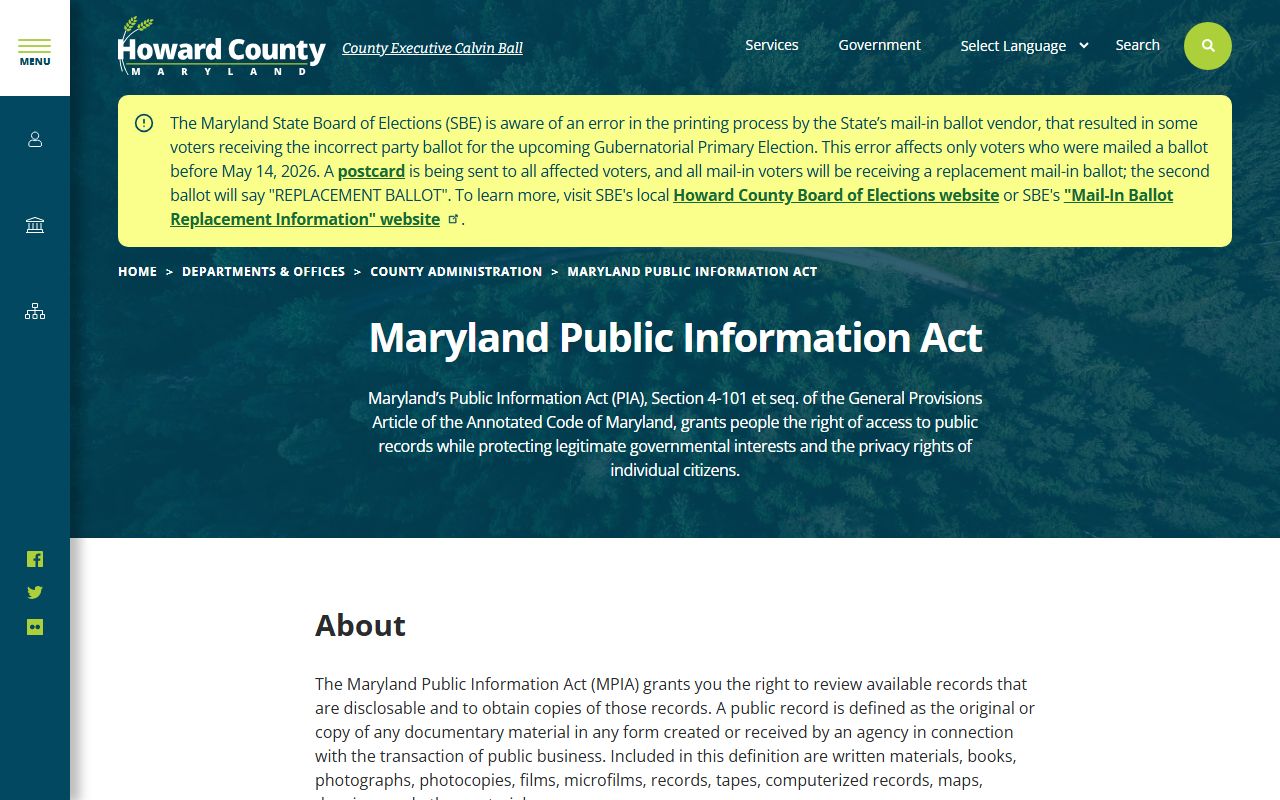
This page is the first stop for anyone submitting a Howard County public records request to a county government office.
Howard County PIA Records vs Court Case Files
There is a meaningful split between county agency records and court records. Both are broadly public, but they live in different systems and follow different rules. Getting this right at the start saves time.
County agency records sit under the Public Information Act. These are documents that Howard County government departments, the Police Department, the Department of Corrections, the Department of Planning, and other county units create or receive. A PIA request goes to the agency that holds the document. The Act sets timelines, fee rules, and an appeal path when access is denied.
Court case files follow Maryland Rules on access to judicial records, specifically Maryland Rules 16-902 and 16-903. Those rules define what a judicial record is and set the general right to inspect it. Court records live with the Clerk of the Circuit Court or the District Court Clerk. They are searched through Maryland Case Search, not through a county PIA request. To get a certified copy of a court order, a divorce decree, or a case docket, the request goes to the Clerk, not to a county PIA contact. Full detail on court filings is on the court records page.
The screenshot from the Maryland Attorney General PIA resources page outlines the PIA framework that applies to county agency records.

The Attorney General's PIA materials are a useful reference when an agency's response is unclear or a denial letter needs to be evaluated.
Note: A PIA request sent to a court clerk's office will not produce case-file documents; those are requested directly from the Clerk under court rules, not the PIA.
What the Howard County Clerk Maintains Beyond Court Files
The Clerk of the Circuit Court for Howard County is one of the most document-rich offices in the county. Wayne A. Robey, the current Clerk, heads an office that goes well beyond civil and criminal case files. The Clerk's duties are set by Maryland law and the rules of the Supreme Court of Maryland.
Land records are a large part of the Clerk's work. Deeds, mortgages, plats, and other conveyances recorded in Howard County are maintained by the Clerk's office under the Land Records and Licensing department, reachable at 410-313-5850. Online images of those documents are available through MdLandRec, which is run by the Maryland State Archives and covers recorded land documents statewide. Survey and subdivision plats are accessed separately through Plats.net, also run with the State Archives.
The screenshot from MdLandRec shows the land records search system where Howard County deeds and mortgages are publicly accessible.
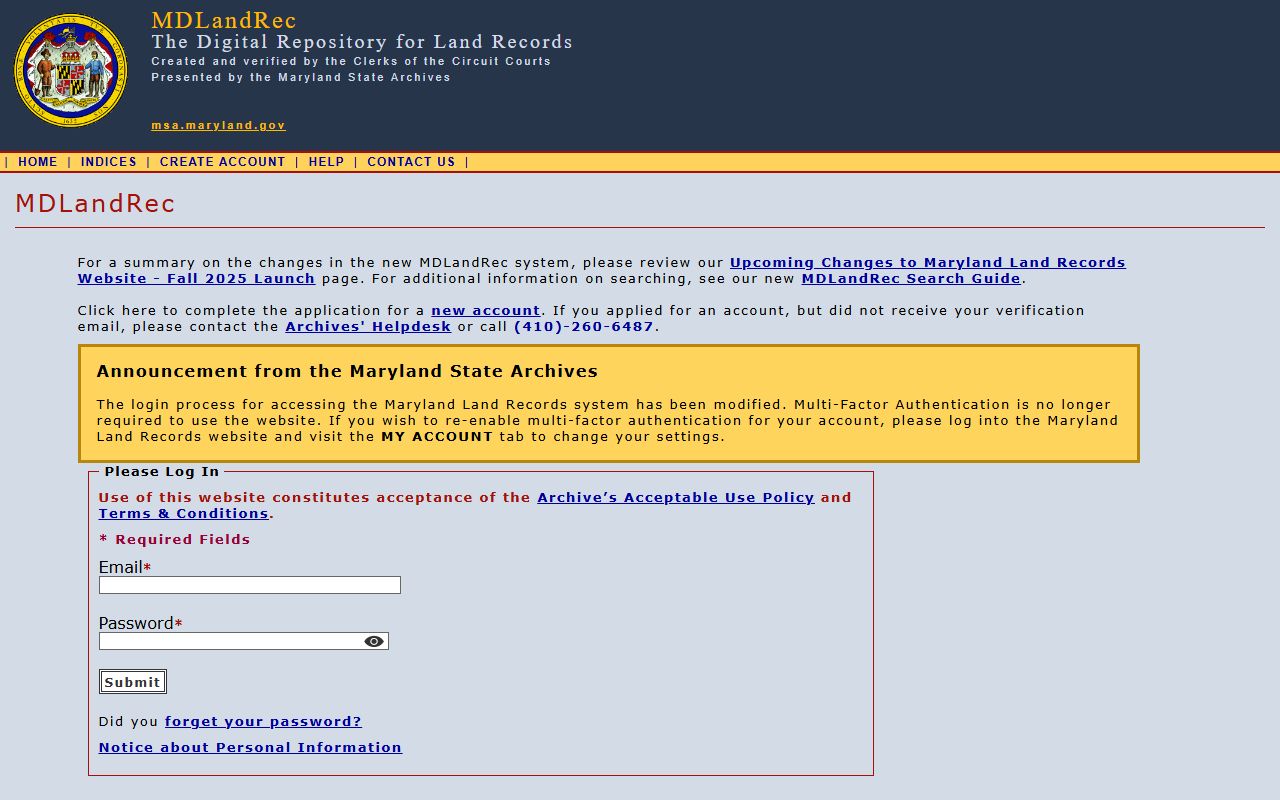
MdLandRec is the correct tool for deed and mortgage searches in Howard County; these documents do not appear in Maryland Case Search.
Beyond land records, the Clerk issues business licenses and marriage licenses, administers oaths to notaries and county officials, and performs civil marriage ceremonies. The full scope of Clerk-maintained records includes:
- Civil court actions filed and maintained by the Civil Department (410-313-3844).
- Criminal and juvenile actions handled by the Criminal/Juvenile Department (410-313-3824).
- Land deeds, mortgages, plats, and conveyances recorded by the Land Records/Licensing Department.
- Business licenses and marriage licenses issued by the Clerk.
- Notary public commissions and oaths administered by the Clerk.
The screenshot from Plats.net shows the plat search portal for Howard County subdivision and survey plats.
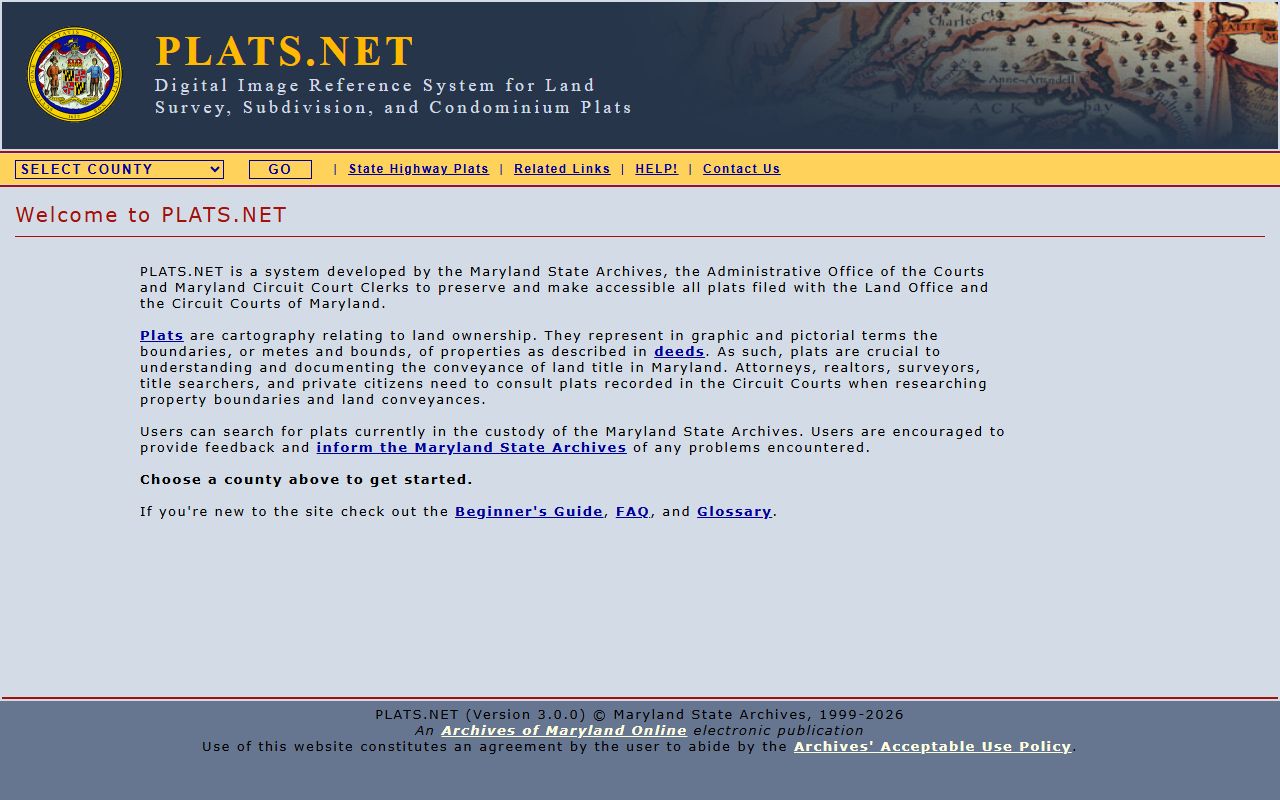
Plats.net covers subdivision, condominium, and survey plats recorded for Howard County properties.
How to File a Howard County Public Records Request
A PIA request to a Howard County agency does not require a lawyer, a special form, or a stated reason. The Act is clear: any person may ask. The key steps are identifying the right office, describing the records well, and submitting through the proper channel. Written requests are strongly recommended even when an agency also accepts verbal asks, because a written record protects your rights on appeal.
- Identify the custodian. Find the county office or department that created or received the record. For police reports, that is the Howard County Police Department. For permits and inspections, it may be Planning or Zoning. For detention or corrections records, it is the Department of Corrections. The Howard County PIA page can help route the request.
- Describe the records clearly. Name the document type, the subject matter, the date range, and any identifying details you have. A vague request slows response times. A request that says "all emails from the Department of Corrections regarding the Behavioral Mental Health Unit between January 2024 and May 2026" is easier to fulfill than one that just says "emails about the jail."
- Submit the request in writing. Send by email, mail, or through the agency's online portal if one exists. Address the written request to the agency's designated PIA custodian. Include your name and contact information so the agency can reach you about fees or clarifications.
- Track the statutory deadline. The Act sets a response obligation. If the agency needs more time, it must notify you. Keep a copy of your submission date and any correspondence. If you receive no response within the statutory window, that is itself grounds for a complaint.
- Respond to any fee notice. Before producing records, the agency may send a fee estimate. Decide whether to proceed, narrow the request to cut costs, or apply for a fee waiver. Written approval from you on fees is typically needed before fulfillment begins.
- Receive the records and review for completeness. Check whether any documents were withheld. If the agency denies access to some or all records, it must provide a written explanation citing the legal basis for denial. That written denial starts your appeal clock.
Howard County Public Records Request Form Fields
A complete request gives the agency enough information to find the records and contact you. A Howard County PIA submission does not require a special government form, but including the fields below in any written request covers everything a custodian needs. The table reflects field categories drawn from both the Howard County PIA guidance and the Clerk's records-request structure.
| Field | Required | Notes |
|---|---|---|
| Requester Name | Yes | Your full legal name. The PIA does not require you to state why you want the records, but the agency needs your identity for fee notices and delivery. |
| Contact Information | Yes | Mailing address, email, or phone. The agency uses this for fee estimates, production notices, and denial letters. |
| Description of Records Requested | Yes | Be specific: document type, subject, dates, and any known identifiers. Vague requests invite delays and broad fee estimates. |
| Date Range | Recommended | Start and end dates narrow the search and reduce fees. Omitting a range often leads to an overly broad result and higher cost. |
| Preferred Delivery Method | Recommended | Email, mail, pickup, or electronic file. Some agencies can produce digital copies at lower cost than paper copies. |
| Fee Agreement / Waiver Request | Conditional | State whether you agree to pay estimated fees up to a dollar amount, or request a waiver. Under General Provisions Section 4-206, waivers are available when disclosure is in the public interest and not primarily commercial. |
PIA Response Timelines for Howard County Requests
The Public Information Act gives county agencies a defined window to respond. General Provisions Section 4-203 governs timing. The agency must acknowledge the request promptly and either produce the records, grant inspection, or explain why more time is needed. If the agency cannot fulfill the request within the standard timeframe, it must notify the requester and give a revised date.
A denial must be in writing. The written denial must state the legal basis for refusing access and must cite the specific statutory exception or rule that applies. This written statement is the document you need if you want to appeal. Keep it. Without a specific legal citation in the denial, the agency may not have followed proper procedure, and that matters if the case reaches the Attorney General or a court.
The timeline rules do not apply to court case records the same way. Court records follow the Maryland Rules. For those, timing is governed by the Clerk's office procedures and any court orders that limit access to specific files. For more on court file access, see the Circuit Court page or the Clerk of the Circuit Court page.
Howard County Public Records Fees and Fee Waivers
Fee authority comes from General Provisions Section 4-206, which allows reasonable fees for search, preparation, and copying. The fee cannot exceed the actual cost to the agency. Fees can cover staff time spent searching and preparing records, but only at a reasonable rate. Copying fees may be charged per page. Electronic delivery, when available, often costs less.
Section 4-206 also provides a waiver path. A requester may ask the agency to waive fees if disclosure is in the public interest and the request is not primarily commercial. Journalists, researchers, and nonprofit organizations commonly invoke this provision. The waiver request should explain why the public benefits from disclosure and why the commercial gain to the requester is minimal or absent.
The table below is a source-pointer guide. The research file used to build this page did not capture specific dollar amounts for each fee category because those amounts are set by individual agency fee schedules and may change. Use the authoritative sources listed to find current rates before submitting a large request.
| Fee Item | Where to Find Current Amount |
|---|---|
| Per-page copy fee (county agencies) | Howard County PIA page or the specific agency's fee schedule. |
| Staff search and preparation fee | General Provisions Section 4-206 sets the authority; agency publishes the rate. |
| Fee waiver | Request in writing under Section 4-206; cite public-interest basis. |
| Court certified copy fees | Maryland Judiciary fee schedule hub; these are not PIA fees. |
| Register of Wills fees | Register of Wills fees page; probate fees are separate from PIA fees. |
The screenshot from the Maryland General Assembly statute text page for Section 4-201 shows the inspection-rights provision that forms the legal foundation for access.
Section 4-201 is the core right-of-access provision. Every PIA denial must identify a specific exception to this general right.
Howard County Public Records That Are Exempt
The PIA contains mandatory and discretionary exemptions. Mandatory denials under General Provisions Section 4-301 apply when inspection would violate another statute that specifically prohibits disclosure. Personnel records, for example, carry privacy protections under Section 4-351. Investigative files that could compromise an ongoing criminal investigation may be withheld. Medical and mental health records, financial account numbers, and Social Security numbers are routinely redacted.
On the court side, restrictions are deeper in some areas. Juvenile delinquency and child welfare case files are not public in the way adult criminal records are. Adoption records are sealed. Expunged criminal records are removed from public inspection after a court grants the petition; Maryland Criminal Procedure Title 10 governs eligibility and process. Shielded records remain in the system but are hidden from broad public access under Criminal Procedure Section 10-110. Grand jury materials are secret unless a court orders disclosure. Sealed case files are restricted by specific court order.
These restrictions do not block all access. Parties to a case, attorneys of record, and authorized government agencies can often access restricted records that the public cannot. If your access need is case-specific, the Clerk of the Circuit Court can tell you what procedures apply.
- Expungement
- A court order removing eligible criminal records from public inspection. The petition is filed in the court tied to the original case.
- Shielding
- A Maryland procedure that hides certain eligible records from public view while leaving access for justice agencies.
- Sealed record
- A record restricted by a specific court order. Access requires a court order to unseal.
- Mandatory denial
- A PIA refusal required by a specific statute that independently prohibits disclosure, not just by the agency's preference.
Appealing a Denied Howard County Public Records Request
A denial does not end the process. Maryland law gives requesters two main paths when a county agency refuses access: the Attorney General's Public Information Act Compliance Board and a civil suit in circuit court.
The Attorney General's office accepts PIA complaints from requesters who believe an agency improperly denied access. The Maryland Attorney General PIA resources page explains how to file a complaint and what the review process involves. This route is faster and cheaper than litigation for most requesters.
If the administrative complaint does not resolve the issue, General Provisions Section 4-362 authorizes judicial enforcement in circuit court. A requester may file a civil action to compel disclosure. The court may award attorney's fees and costs to a prevailing requester, which can deter agencies from making improper denials. The Circuit Court for Howard County at 9250 Judicial Way in Ellicott City is where such an action would be filed if the agency is a Howard County government unit.
Before going that far, check the denial letter. A weak or boilerplate denial that does not cite a specific statutory exception may be correctable with a follow-up letter pointing out the deficiency. Agencies sometimes reconsider when a requester pushes back in writing with a specific legal argument.