
How to Find Recently Released Howard County Inmates
No public online roster of recent releases exists for the Howard County Detention Center. Howard County official sources do not include a real-time or recent-release list that the public can browse. The Howard County Department of Corrections operates the Detention Center at 7301 Waterloo Road in Jessup and confirms that security staff process all intake and release activity around the clock. Release is an operational function, not a data feed sent to a public portal.
What you can do is contact the Department of Corrections directly by phone or in person to ask whether a specific person has been released from local custody. Staff can confirm custody status for current or recently held individuals. This is the most direct path for local jail releases. For people who were sentenced to a state facility after time in Howard County, the Maryland DPSCS inmate locator covers sentenced state prisoners. If someone served federal time, the Bureau of Prisons locator covers federal inmates released after 1982. Each system is separate, and a person may move from local to state to federal custody or back. Checking all three gives the fullest picture.
Local jail stays are often short, covering pretrial detention or short sentences. The Detention Center holds pre-trial, pre-sentenced, and sentenced adult male and female offenders under the same roof. Most people released from the Howard County facility walk out without any public notification being issued unless a victim or interested party has set up a VINELink alert in advance.
Note: Absence from an online search does not mean a person has been released; it may mean the locator has not updated or that the person was never entered into a specific database.
Setting Up Howard County Release Notifications via VINELink
VINELink is the national victim notification system used by participating local and state agencies across Maryland. When an offender's custody status changes, registered users get an alert by phone, email, or text. Maryland agencies participate in VINELink, which means Howard County Detention Center releases can trigger notifications for anyone who has registered and tied an alert to a specific person. The service is free to use.
VINELink searches by name and state, then lets you register contact details to receive future status changes. The field inventory below shows what the registration form asks for.
| Field Label | Type | Required | Notes |
|---|---|---|---|
| State | Dropdown | Yes | Select Maryland to search Howard County agencies. |
| Name / ID | Text | Yes | Search by the offender's name or ID where available. |
| Facility / Agency | Dropdown | Optional | Narrows results to a specific jail or prison. |
| Notification registration | Web form | Optional | Phone, email, or text options; confirm current options on site. |
To register for alerts, follow these steps at vinelink.com:
- Go to the VINELink site and choose Maryland as your state.
- Search for the person by name or offender ID number.
- Select the matching record from the results list.
- Choose your notification method: phone call, email, or text message.
- Enter your contact information and confirm your registration.
- VINELink will send an alert each time that person's custody status changes.
VINELink does not show a full release history and is not a substitute for contacting the facility directly. It works best as a forward-looking alert tool, not as a look-back search.
The screenshot below comes from the VINELink notification platform, which Maryland agencies use to push custody-change alerts to victims and registered users.
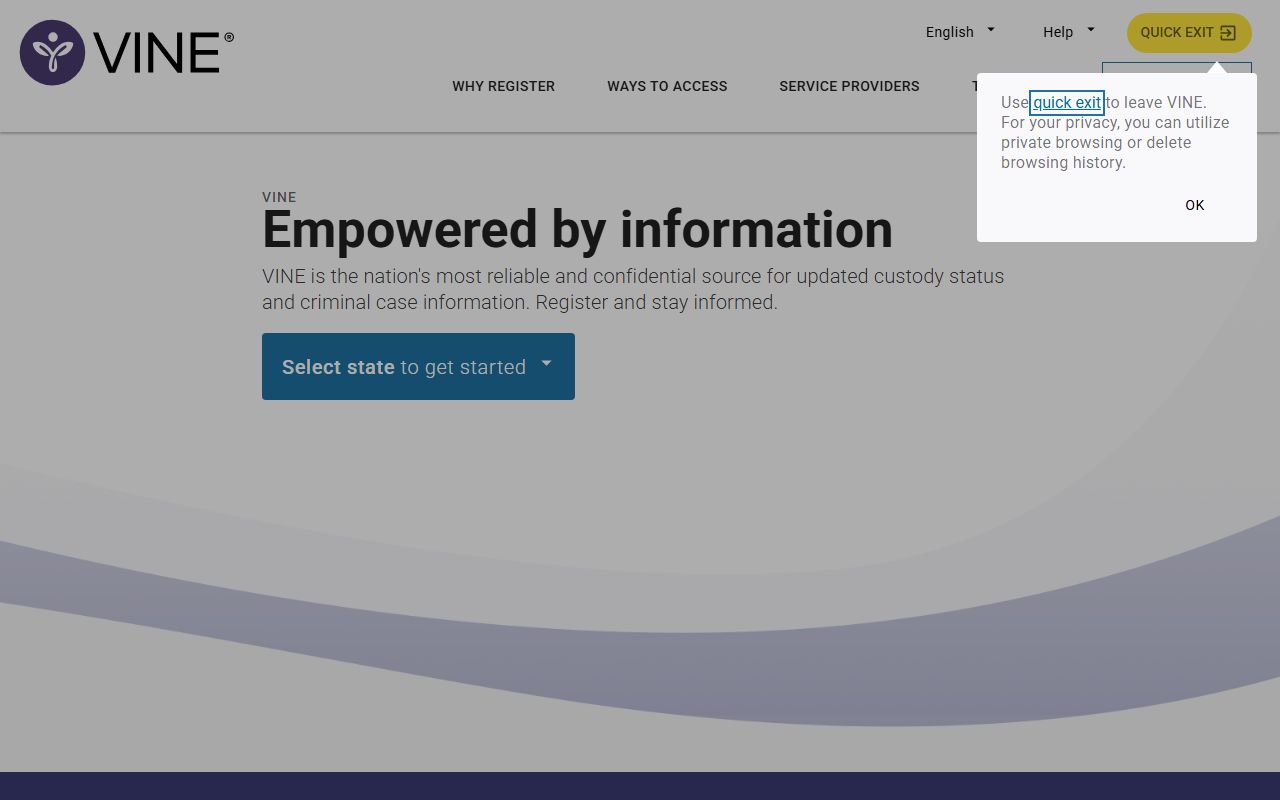
VINELink's Maryland setup covers participating county jails and state facilities, so a single registration can span both the local Howard County Detention Center and any state transfer that follows.
Searching State and Federal Released Howard County Inmates
When a Howard County resident is convicted of a more serious offense, they often transfer from the Detention Center to a Maryland state correctional facility. The Maryland Department of Public Safety and Correctional Services inmate locator covers sentenced state prisoners. It can show whether someone is currently in a state facility or has been released, depending on how current the data is. DPSCS operates state prisons across Maryland, and its locator is the official channel for state-level custody status.
The table below shows the search fields the DPSCS locator uses. Name searches need exact spelling for the best results. An inmate ID, called a DOC ID, gives a faster and more precise lookup when you have it.
| Field Label | Type | Required | Notes |
|---|---|---|---|
| First Name | Text | Optional | Helps narrow common last names. |
| Last Name | Text | Strongly recommended | Use exact spelling; no wildcard noted on this system. |
| DOC ID / Inmate ID | Text | Optional | Best exact lookup if you have the number. |
| Search | Button | Yes | Submits the query to the DPSCS database. |
Federal cases are different. Howard County residents charged with federal crimes appear before the U.S. District Court for the District of Maryland and, if convicted, serve time in a federal Bureau of Prisons facility. The BOP inmate locator covers federal inmates released after 1982. You can search by name or by register number. The table below shows the BOP locator fields.
| Field Label | Type | Required | Notes |
|---|---|---|---|
| Find by Number | Tab | Optional | Accepts Register Number, DCDC, FBI, or INS number. |
| First Name | Text | Optional | Use for name-based searches. |
| Middle Name | Text | Optional | Helps when the last name is common. |
| Last Name | Text | Required for name search | Exact spelling gives the best results. |
| Race | Dropdown | Optional | BOP-defined categories; narrows a large result set. |
| Age | Number | Optional | Approximate age to filter results. |
| Sex | Dropdown | Optional | Male or female selection. |
The BOP locator covers people who served federal sentences, including those whose cases originated in Maryland federal courts. When a person has completed federal time, their record may still appear in the locator with a released status, making it a useful confirmation tool even after someone has left federal custody.
The image below links to the Bureau of Prisons inmate locator, the official federal database for released and currently housed federal inmates.
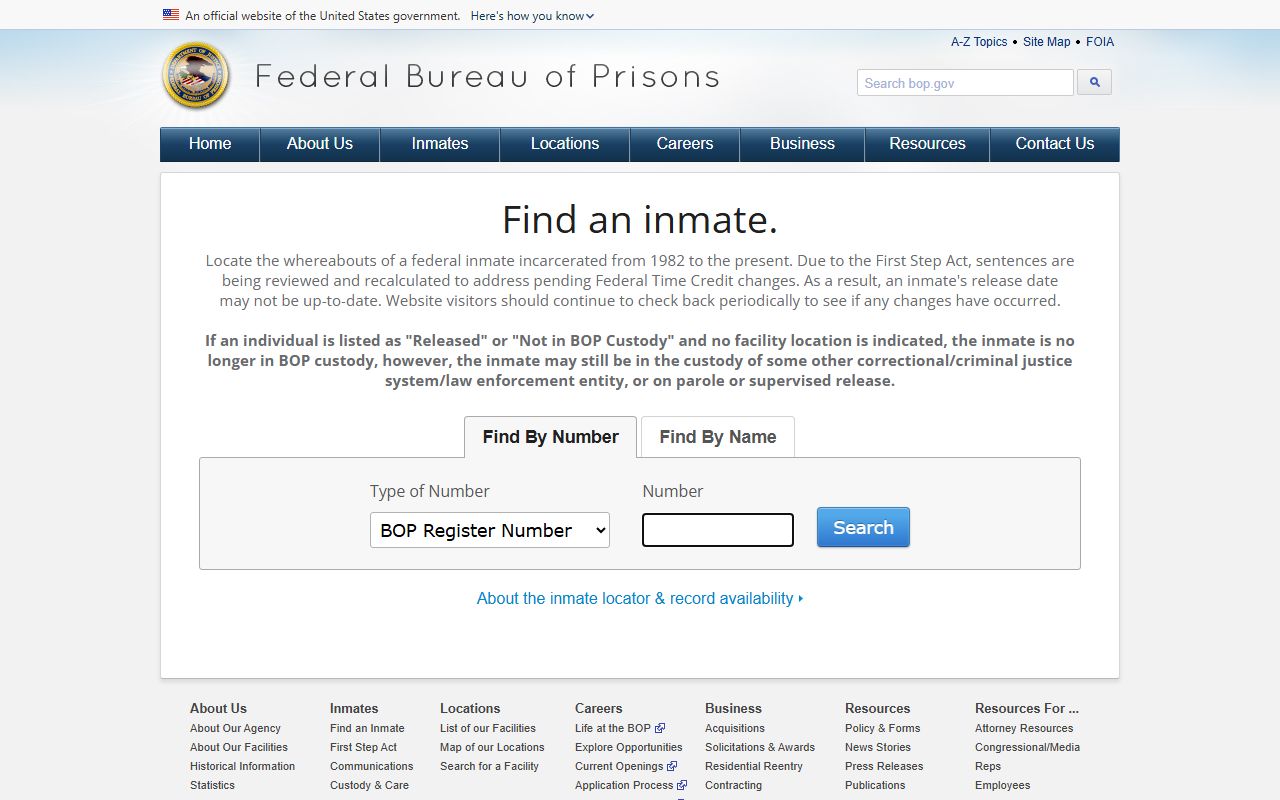
Howard County residents convicted at the federal level go through the BOP system, not the DPSCS system, so both databases are worth checking when the original charge level is unclear.
Verifying Howard County Release in Person or by Phone
Online locators are helpful but not always current. Release processing happens at the facility, and system updates may lag by hours or longer. If you need to confirm that a person has left Howard County custody right now, the most reliable approach is a direct call or visit to the Department of Corrections.
The Howard County Detention Center staff process all releases and can confirm whether a named individual has been discharged. Keep in mind that staff can confirm custody status but cannot give legal advice or tell you anything about the person's case, charges, or conditions of release. For information about ongoing supervision, contact the relevant parole or probation office instead.
If the person was held under a state or federal detainer, release from the Howard County facility does not mean full release from custody. A detainer means another agency has a hold on the person, and they would typically be transported rather than released to the street. Clarifying whether any detainers exist is something an attorney can help with. The Maryland Office of the Public Defender serves people who cannot afford private counsel and can assist with questions about holds and conditions.
Howard County Department of Corrections
Howard County Detention Center
7301 Waterloo Road
Jessup, MD 20794
The Maryland Sex Offender Registry After Howard County Release
Maryland requires certain sex offenders to register with the state upon release. The Maryland Sex Offender Registry, maintained by DPSCS, is a public database that lets anyone search for registered sex offenders by name, location, or address proximity. Howard County residents who have been convicted of qualifying offenses and released from custody must register, and their information becomes publicly searchable through this system.
The registry shows current registration status, address (where public law allows), offense information, and photo where available. It is updated as registrants comply with reporting requirements. Registration does not capture every released person; it applies only to those convicted of offenses that trigger registration obligations under Maryland law. People who are not required to register will not appear here regardless of their offense history.
The table below shows the fields available on the Maryland sex offender registry search.
| Field Label | Type | Required | Notes |
|---|---|---|---|
| Name | Text | Optional | Search registrants by first or last name. |
| County / City / ZIP | Text or Dropdown | Optional | Use Howard County, Ellicott City, Columbia, or a ZIP code to narrow results. |
| Address radius | Dropdown | Optional | Geographic proximity search if available on the interface. |
| Search | Button | Yes | Returns public registrant profiles matching your criteria. |
To check whether a specific person released from Howard County is on the registry, search by name and narrow the location to Howard County or the ZIP codes covering Ellicott City, Columbia, Jessup, or wherever the person is expected to reside. The registry is not a comprehensive released-inmate list; it is a registration database for a specific legal category of offenders.
Howard County Parole and Probation Information
Maryland divides post-release supervision into parole and probation. Parole applies to people released from prison before their sentence ends; it is supervised release with conditions. Probation is a sentence served in the community under court-ordered conditions, often instead of or following incarceration. Both can apply to Howard County residents released from state custody. Violation of either can result in a return to custody.
The Maryland Parole Commission handles parole decisions for state sentenced offenders. The Division of Parole and Probation, an arm of DPSCS, supervises both parolees and probationers across the state, including Howard County. Supervisees typically must report to a supervising agent on a schedule, follow curfew and travel conditions, maintain employment or program enrollment, avoid new arrests, and stay away from specified locations or persons. The conditions vary by case.
People released from Howard County Detention Center on local sentences may be placed on probation by the Circuit Court or District Court as part of their sentence. Those conditions come from the sentencing judge's order. For questions about specific conditions, contact the supervising court or an attorney. The Maryland Office of the Public Defender provides indigent representation for people facing revocation proceedings who qualify financially.
Maryland Office of the Public Defender
6 Saint Paul Street, Suite 1400
Baltimore, MD 21202
Note: The Public Defender office has regional offices that serve Howard County residents. Contact the main office or check their site to find the local intake number for Howard County cases.
Reentry Resources in Howard County
The Howard County Department of Corrections runs an active reentry program for people preparing to leave custody and return to the community. The official Corrections page describes programs available both before and after release. These include transition counseling, housing assistance, employment support, health and mental health care, substance-use-disorder counseling, medication-assisted treatment, education, and anger management services. The goal is to reduce the barriers that increase the chance of someone returning to custody.
One of the stronger local programs is the Work Release Program. It serves nonviolent convicted incarcerated individuals who are close to their release date. Participants leave the facility each day to go to a job, then return at night. Work release lets people rebuild income, maintain employment ties, and ease back into daily life before full release. Not everyone qualifies; placement depends on the nature of the offense, behavior record, and assessment by corrections staff.
The Behavioral Mental Health Unit at the Howard County Detention Center provides dedicated housing and rehabilitative programming for residents with mental health needs. Services are offered during incarceration, but the transition planning that follows is part of the broader reentry effort. People leaving the facility who need ongoing mental health or substance-use support are connected to community resources before release when possible.
Beyond the Corrections department's own programs, statewide reentry resources supplement local services. Maryland 211 connects callers to housing, food, employment, and health resources across the state. Maryland Legal Aid and the Pro Bono Resource Center of Maryland offer civil legal help, including expungement clinics, which can remove eligible records from public view and remove obstacles to housing and jobs. The Maryland Office of the Public Defender handles criminal defense for those who qualify financially, including post-release supervision and revocation matters.
- Howard County Department of Corrections Work Release Program: employment-focused pre-release program for qualifying nonviolent offenders.
- Transition counseling at the Detention Center: housing, jobs, health, mental health, and substance-use planning before and after release.
- Behavioral Mental Health Unit: dedicated mental health housing and rehabilitative programs at the Detention Center.
- Maryland 211: statewide hotline for social services, housing, food, employment, and health resources after release.
- Maryland Legal Aid: civil legal services statewide, including housing, family, and expungement matters.
- Pro Bono Resource Center of Maryland: free legal clinics covering expungement and consumer/housing issues.
The image below connects to the Maryland Office of the Public Defender, which provides legal representation for qualifying individuals facing criminal charges, including post-release revocation hearings in Howard County.

The Public Defender's office is a key contact for anyone released from Howard County custody who faces a probation or parole revocation charge and cannot afford a private attorney.
Civil Rights and Voting Restoration After Howard County Release
Maryland generally restores voting rights automatically upon release from incarceration for a felony conviction. People who complete their sentence and are no longer in custody are eligible to register and vote. People held pretrial or serving time for a misdemeanor conviction may retain their voting rights throughout their case and sentence. This is a notable feature of Maryland law and affects many Howard County residents who have been incarcerated.
The process for registering or re-registering to vote after release is handled through the Maryland State Board of Elections. Individuals should confirm their eligibility and registration status directly with the Board rather than relying on general information, since individual circumstances can affect timing. The Board's site explains online registration, in-person registration, and what documentation is needed.
Firearm rights and professional licenses are different matters. A felony conviction can result in a permanent bar on possessing firearms under both Maryland and federal law. Some professional licenses can be suspended or revoked after a conviction, and restoration rules vary by license type and agency. Expungement or shielding of an eligible record under Maryland Criminal Procedure can help with some licensing and employment barriers, though it does not automatically restore firearm rights. People with questions about their specific rights after release should consult an attorney or reach out to Maryland Legal Aid for guidance on next steps.
Howard County residents who want to clean up their record after release can file an expungement petition in the court tied to their case under Criminal Procedure Title 10. Eligible outcomes include acquittals, dismissals, nolle prosequi, certain stet dispositions, and probation before judgment after the required waiting period. Shielding under Criminal Procedure Section 10-110 covers some additional categories. Both processes are covered in more detail on the arrest records page.